No ‘bad’ abortions
Freeman, C., & Nandagiri, R. (2023). No 'bad' abortions: Graphic narratives as abortion discourse. MAI: Feminism and Visual Culture, (10). https://maifeminism.com/no-bad-abortions-graphic-narratives-as-feminist-discourse/
Cordelia and I were both working on graphic novels about abortion in our different contexts, and Cordy had the fantastic idea to write about it for this MAI issue on Feminist Discourse in Comics and Graphic Novels.
We co-authored this over the course of two months and submitted it well before the deadline! This conversational format for an academic article was new to me, but I think it builds on feminist praxis and harks back to a genealogy of feminist conversations that underpin so much of this radical, destabilising, anarchic work of feminist comics and graphic novels.
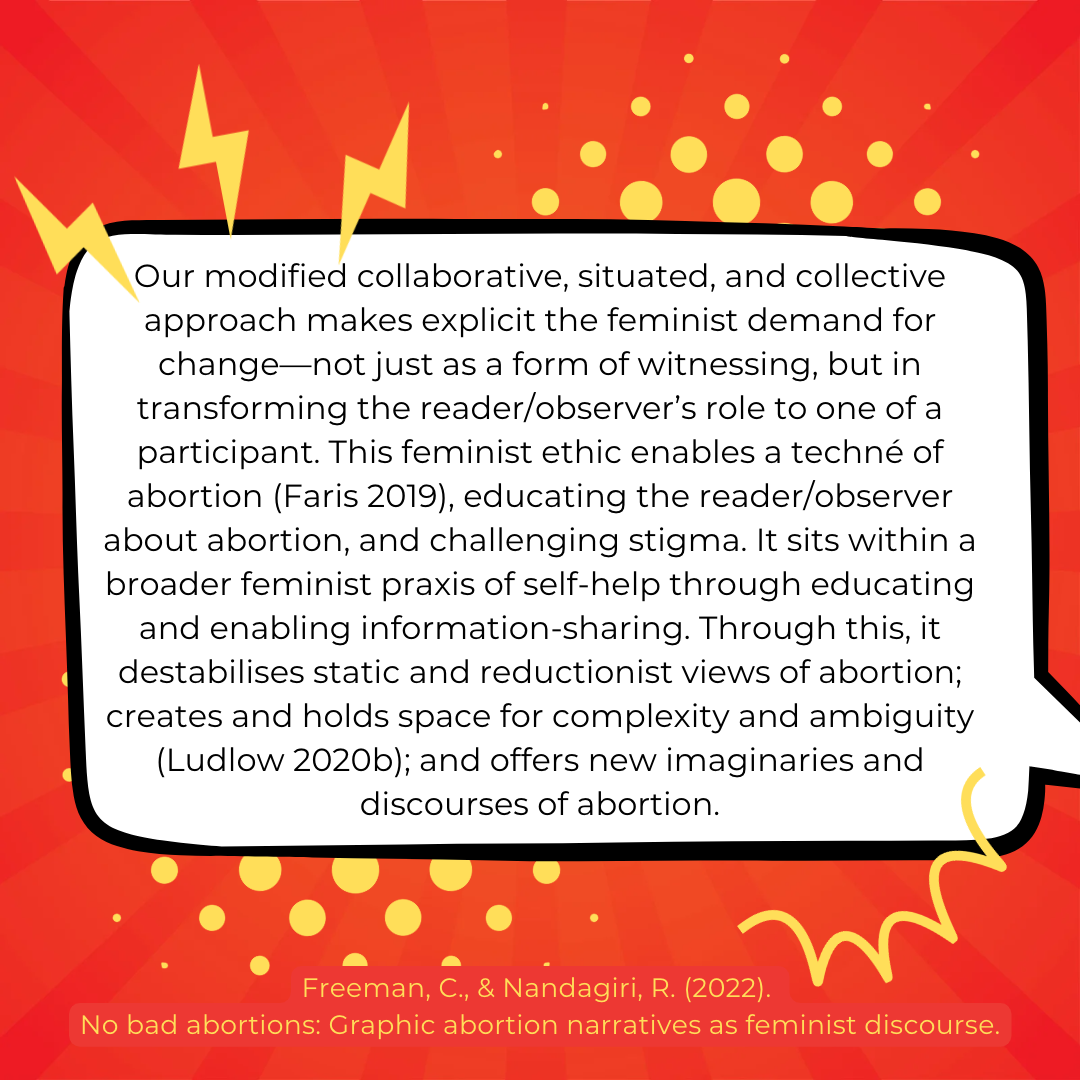
What we became interested in, through this piece, is what graphic abortion narratives do. Rather than treating them as simply illustrative or communicative tools, we argue that they function as a form of feminist discourse in their own right, one that challenges dominant ways of understanding abortion.
Through their visual and narrative form, these works make space for embodied, emotional, contradictory, and plural experiences of abortion that are often excluded from biomedical, legal, or policy framings. They allow abortion to be represented not as exceptional, tragic, or morally fraught in predictable ways, but as lived, varied, and complex.
This is where the idea of “no bad abortions” is important- graphic narratives refuse the binary of “good” versus “bad” abortions, where some experiences are seen as legitimate or deserving, and others as suspect or unjustifiable. Instead, they insist on the validity of a wide range of abortion experiences, without requiring them to conform to socially acceptable scripts. In that sense, graphic abortion narratives do more than represent abortion, they reshape how abortion is understood, felt, and spoken about. They are part of a broader feminist project of challenging stigma, unsettling dominant discourses, and creating space for more expansive ways of thinking about reproductive life.
Not long after publication, Cordy and I were both at a conference where a panellist referenced this piece. To say I was delighted would be an understatement!